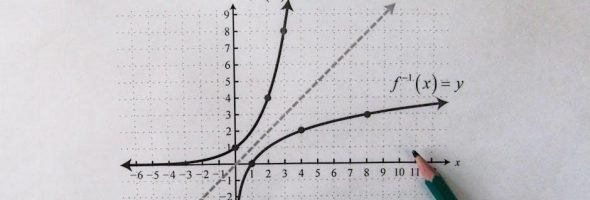
Simple Mathematics PDFs offer accessible learning resources, stemming from languages like BASIC, and are vital for foundational skill development.
What are Simple Mathematics PDFs?
Simple Mathematics PDFs are digital documents, typically in Portable Document Format, designed to teach fundamental mathematical concepts. These resources often trace their roots back to early programming languages like BASIC, initially created for beginner programmers. They encompass a wide range of topics, from basic arithmetic operations – addition, subtraction, multiplication, and division – to more complex ideas like fractions, decimals, and introductory algebra.
These PDFs serve as self-contained learning modules, frequently including explanations, examples, and practice problems. They are designed for independent study, offering a flexible and accessible way to grasp core mathematical principles. The format ensures consistent presentation across different devices, making them a reliable learning tool.
Why Use PDFs for Learning Mathematics?
Simple Mathematics PDFs offer numerous advantages for learners. Their portability allows access on various devices – computers, tablets, and smartphones – facilitating learning anytime, anywhere. The fixed-layout format ensures consistent presentation, unlike web pages that can render differently. PDFs are often free or low-cost, making them an accessible resource for students of all backgrounds.
Furthermore, PDFs support offline access, eliminating the need for a constant internet connection. They frequently include interactive elements like fillable forms for practice problems. Considering the historical context, even early systems relied on languages like BASIC, PDFs represent a modern evolution of accessible educational materials, providing a structured and convenient learning experience.

Basic Mathematical Concepts Covered in PDFs
Simple Mathematics PDFs commonly cover arithmetic, fractions, decimals, and percentages – foundational skills, much like the basics of early programming languages.
Arithmetic Operations
Arithmetic operations form the cornerstone of simple mathematics, and PDFs dedicated to this subject provide comprehensive coverage of fundamental concepts. These resources typically begin with addition and subtraction, illustrating how to combine and reduce quantities using whole numbers and, progressively, decimals.
Multiplication and division are then introduced, often with a focus on memorizing times tables and understanding the inverse relationship between these operations. PDFs frequently include numerous practice problems, ranging from basic calculations to word problems designed to test comprehension and application of these skills. The goal is to build a solid foundation for more advanced mathematical concepts, mirroring the step-by-step approach found in introductory programming like BASIC.
Addition and Subtraction
Addition and subtraction, the most basic arithmetic operations, are thoroughly explained in simple mathematics PDFs. These resources often start with visual aids – like counting objects – to illustrate the concepts of combining (addition) and taking away (subtraction).
PDFs progressively introduce numerical problems, beginning with single-digit calculations and gradually increasing complexity to multi-digit operations, potentially including borrowing and carrying. Emphasis is placed on understanding the properties of these operations, such as the commutative property of addition. Like the foundational principles of BASIC programming, mastering these skills is crucial. Practice exercises, with provided solutions, reinforce learning and build confidence, preparing learners for more complex mathematical tasks.
Multiplication and Division
Multiplication and division are presented in simple mathematics PDFs as repeated addition and equal sharing, respectively. These PDFs often utilize times tables and visual representations – like arrays – to solidify understanding of multiplication. Division is explained through concepts like grouping and remainders, building upon the foundational arithmetic skills.
Similar to learning a programming language like BASIC, consistent practice is key. PDFs provide numerous practice problems, ranging from simple fact recall to more complex word problems. They emphasize the inverse relationship between multiplication and division, aiding in problem-solving. Step-by-step solutions are frequently included, allowing learners to identify and correct errors, fostering a strong grasp of these essential mathematical operations.
Fractions and Decimals
Fractions and decimals are introduced in simple mathematics PDFs as parts of a whole, building upon basic arithmetic. These resources often begin with visual representations – like pie charts or shaded areas – to illustrate fractional concepts; PDFs explain numerator and denominator roles, and equivalent fractions are demonstrated through examples.
The connection between fractions and decimals is emphasized, mirroring the progression from BASIC programming to more complex systems. PDFs detail converting fractions to decimals (and vice versa) using division. Practical applications, such as measuring ingredients or calculating discounts, are frequently included. Practice problems reinforce these skills, with solutions provided to aid self-assessment and understanding of these fundamental mathematical concepts.
Understanding Fractions
Simple Mathematics PDFs dedicate significant space to demystifying fractions, presenting them as representations of equal parts of a whole. These resources typically begin by visually illustrating fractions – using shapes divided into segments – to build intuitive understanding. Key terminology, like numerator (parts considered) and denominator (total parts), is clearly defined and consistently applied.
PDFs often explore equivalent fractions, demonstrating how different fractions can represent the same value, similar to the evolution from BASIC to Pascal. Concepts like simplifying fractions to their lowest terms are explained with step-by-step examples. Comparisons of fractions – determining which is larger or smaller – are also covered, often utilizing visual aids and number line representations. The goal is to establish a solid foundation for future mathematical operations.
Converting Between Fractions and Decimals
Simple Mathematics PDFs bridge the gap between fractions and decimals, explaining their interconnectedness; They demonstrate converting fractions to decimals through division – dividing the numerator by the denominator. This process is often illustrated with long division examples, ensuring clarity. Conversely, PDFs detail converting decimals to fractions, focusing on identifying the place value of the last digit and expressing it as a denominator.
These resources frequently highlight repeating decimals and their fractional equivalents, a concept that can initially be challenging. They may use patterns and algebraic methods to represent repeating decimals as fractions. Like the shift from BASIC to more complex languages, understanding this conversion is a crucial step towards advanced mathematical concepts. Practice problems with solutions reinforce the learned techniques, building confidence and proficiency.
Percentages
Simple Mathematics PDFs dedicate significant space to percentages, a fundamental concept with widespread applications. They define percentages as parts per hundred, illustrating this with visual aids like pie charts and grids. PDFs thoroughly explain calculating percentages of a given number, often using real-world examples like discounts, taxes, and tips. They emphasize converting percentages to decimals and fractions, reinforcing the interconnectedness of these mathematical representations.
Furthermore, these resources cover percentage increase and decrease, detailing how to calculate the difference and express it as a percentage of the original value. Similar to mastering BASIC programming fundamentals, grasping these concepts builds a strong foundation for more complex calculations. Practice problems, complete with step-by-step solutions, are included to solidify understanding and build problem-solving skills.
Calculating Percentages
Simple Mathematics PDFs provide clear, step-by-step instructions for calculating percentages. They typically begin by converting the percentage to a decimal by dividing by 100. This decimal is then multiplied by the total amount to find the percentage value. For instance, finding 20% of 80 involves converting 20% to 0.20 and multiplying it by 80, resulting in 16.
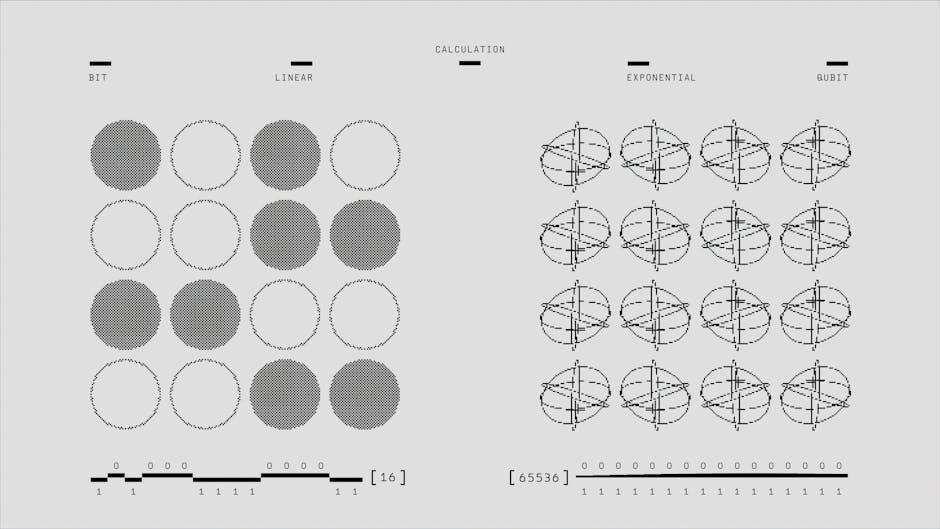
These PDFs often utilize relatable examples, such as calculating sales tax or determining discounts, to demonstrate practical application. They emphasize the importance of understanding the “of” keyword, signifying multiplication in percentage problems. Like learning the basics of BASIC, mastering this skill is crucial. Numerous practice problems, with detailed solutions, are included to reinforce the concept and build confidence in applying the technique.
Percentage Increase and Decrease
Simple Mathematics PDFs expertly explain percentage increase and decrease, building upon the foundation of basic percentage calculations. They demonstrate how to find the amount of change by subtracting the original value from the new value. This difference is then divided by the original value, and finally multiplied by 100 to express the change as a percentage.
For example, a price increase from $50 to $60 involves a $10 increase. Dividing $10 by $50 yields 0.20, which, when multiplied by 100, reveals a 20% increase. Similar methods apply to decreases. These PDFs often highlight the importance of identifying the original value as the denominator. Just as BASIC provided a starting point, these concepts form a core mathematical understanding.

Algebraic Foundations in Simple Mathematics PDFs
Simple Mathematics PDFs introduce variables and equation solving, mirroring the accessibility of early programming languages like BASIC, fostering crucial algebraic skills.
Variables in simple mathematics PDFs represent unknown quantities, often denoted by letters like ‘x’ or ‘y’. These PDFs clearly explain how variables act as placeholders in equations, allowing students to explore relationships between numbers. Much like the foundational principles of BASIC programming, where variables store data, mathematical variables hold numerical values.
Understanding variables is crucial for building algebraic skills. PDFs often present real-world examples to illustrate their use, such as calculating the cost of multiple items or determining distances traveled at a constant speed. They demonstrate how to substitute values into variables to solve for unknowns, a core concept in algebra. The best PDFs progressively introduce variables, starting with simple expressions and gradually increasing complexity.
These resources emphasize that variables aren’t just abstract symbols; they represent tangible quantities, making the learning process more intuitive and accessible.
Solving Simple Equations
Simple Mathematics PDFs provide step-by-step guidance on solving equations, building upon the introduction of variables. These resources emphasize the importance of maintaining balance – whatever operation is performed on one side of the equation must also be applied to the other. This mirrors the logical structure found in programming languages like BASIC, where operations must adhere to specific rules.
PDFs typically begin with one-step equations, such as x + 5 = 10, demonstrating how to isolate the variable using inverse operations (subtraction in this case). They then progress to two-step equations and beyond, illustrating techniques like combining like terms and distributing.
Worked examples are a key feature, showing students exactly how to approach each problem. Many PDFs also include practice exercises with solutions, allowing for self-assessment and reinforcement of learned concepts. The goal is to build confidence and proficiency in algebraic manipulation.
Order of Operations (PEMDAS/BODMAS)
Simple Mathematics PDFs dedicate significant attention to the order of operations, often presented using the acronyms PEMDAS (Parentheses, Exponents, Multiplication and Division, Addition and Subtraction) or BODMAS (Brackets, Orders, Division and Multiplication, Addition and Subtraction). This is crucial for consistently arriving at the correct answer in mathematical expressions.
These PDFs illustrate how to evaluate expressions with multiple operations by following a strict sequence. They emphasize that multiplication and division have equal priority, as do addition and subtraction, and are performed from left to right. The foundational logic parallels structured programming, like BASIC, where code execution follows a defined order.
Numerous examples demonstrate applying PEMDAS/BODMAS to various problems, including those involving fractions, decimals, and negative numbers. Practice exercises with detailed solutions reinforce understanding and prevent common errors. Mastering this concept is essential for success in more advanced mathematical topics.

Geometry Basics Found in PDFs
Geometry PDFs cover fundamental shapes, properties, and calculations for area and perimeter, building upon basic mathematical principles for spatial understanding.
Shapes and Their Properties
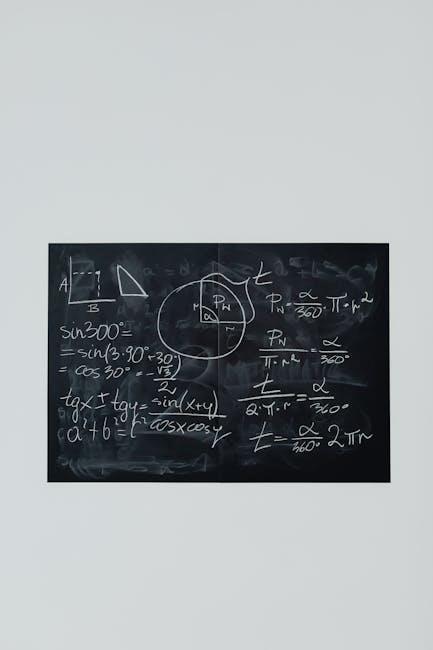
Simple Mathematics PDFs frequently introduce foundational geometric shapes, providing a visual and practical understanding of their characteristics. These commonly include two-dimensional figures like circles, squares, rectangles, triangles, and polygons. PDFs detail properties such as the number of sides, angles, and lines of symmetry for each shape.
Furthermore, they explore three-dimensional shapes like cubes, spheres, cylinders, and cones, explaining concepts like faces, edges, and vertices. Understanding these properties is crucial for solving problems related to area, perimeter, volume, and surface area. The PDFs often use diagrams and illustrations to aid comprehension, making the learning process more intuitive and accessible for beginners. This builds a strong base for more advanced geometric concepts.
Area and Perimeter Calculations
Simple Mathematics PDFs dedicate significant space to mastering area and perimeter calculations for various shapes. They begin with fundamental formulas for rectangles (Area = length x width, Perimeter = 2 x (length + width)) and squares (Area = side x side, Perimeter = 4 x side).
Progressing to more complex shapes, PDFs provide guidance on calculating the area and circumference of circles (Area = πr², Circumference = 2πr) and the area of triangles (Area = ½ x base x height). Step-by-step examples and practice problems are included to reinforce understanding. These resources emphasize the importance of units and dimensional analysis, ensuring accurate results. Mastering these calculations is essential for real-world applications and further mathematical studies.

Resources for Finding Simple Mathematics PDFs
Numerous online platforms and educational websites provide free Simple Mathematics PDFs, alongside institutions offering downloadable resources for learners of all ages.
Online Educational Platforms
Several online educational platforms serve as excellent repositories for Simple Mathematics PDFs. Khan Academy, for instance, provides a comprehensive library of math resources, including downloadable worksheets and practice exercises covering arithmetic, algebra, and geometry – all frequently available in PDF format. Coursera and edX often host introductory math courses with accompanying PDF materials for students to reinforce their learning.
Furthermore, websites like CK-12 Foundation offer free, customizable textbooks and learning materials, many of which can be downloaded as PDFs. These platforms often categorize content by grade level and topic, making it easy to find relevant resources. Utilizing these platforms allows for self-paced learning and access to a wide range of mathematical concepts presented in a clear and concise manner, mirroring the foundational approach of languages like BASIC.
Free PDF Download Websites
Numerous websites specialize in offering free PDF downloads, including a wealth of Simple Mathematics resources. Websites like PDF24 Creator and Smallpdf allow users to create, convert, and download PDFs, potentially including self-made or sourced math materials. However, caution is advised when using such sites; always verify the source and content accuracy.
Many educational resource websites also provide free PDF downloads of worksheets, textbooks, and practice problems. Searching for specific topics like “basic algebra PDF” or “geometry worksheets PDF” can yield relevant results. Remember to prioritize reputable sources to ensure the quality and correctness of the information, avoiding potentially misleading or inaccurate materials – a crucial aspect, much like ensuring correct code in BASIC programming.
Educational Institutions’ Websites
Universities and colleges frequently publish Simple Mathematics PDFs on their websites, often as supplementary materials for introductory courses. These resources, similar to early BASIC programming manuals, provide foundational knowledge in arithmetic, algebra, and geometry. Institutions like MIT OpenCourseWare and Khan Academy offer extensive collections of free educational content, including downloadable PDFs covering a wide range of mathematical topics.
Furthermore, many school districts and educational organizations provide access to PDF worksheets, lesson plans, and practice exams through their online portals. These materials are typically aligned with specific curriculum standards and are designed to support student learning. Checking the websites of local schools or educational departments can reveal valuable resources for reinforcing mathematical concepts, mirroring the structured learning approach of languages like Pascal.
Tips for Effectively Using Simple Mathematics PDFs
Maximize learning by actively solving problems, reviewing solutions, and consistently practicing concepts presented within the Simple Mathematics PDF materials.

Active Learning Techniques
Engage deeply with Simple Mathematics PDFs beyond passive reading. Implement techniques like the Feynman Technique – explain concepts as if teaching someone else. This reveals gaps in understanding.
Practice consistently; don’t just read examples, solve them independently. Utilize spaced repetition, revisiting topics at increasing intervals to reinforce memory. Annotate PDFs directly, highlighting key formulas and definitions.
Create flashcards for essential terms and equations. Form study groups to discuss challenging problems and share different approaches. Relate mathematical concepts to real-world scenarios to enhance comprehension and retention. Avoid simply memorizing; strive for conceptual understanding, mirroring the goals of early programming languages like BASIC, which emphasized accessibility.
Practice Problems and Solutions
Simple Mathematics PDFs are most effective when paired with diligent practice. Seek out PDFs that include a wide range of problems, varying in difficulty, to solidify understanding. Don’t shy away from challenging questions; they foster deeper learning.
Always check solutions, but initially attempt problems independently. Analyze errors – understand why a solution is incorrect, not just what the correct answer is. Many PDFs offer step-by-step solutions, mirroring the iterative nature of early programming like BASIC.
Create your own problems based on the concepts learned. This tests comprehension and encourages creative application of mathematical principles. Regularly review solved problems to reinforce retention and build confidence, much like mastering fundamental skills.